📊 Polymarket's clout stock market
Plus: Kalshi hedges sportsbooks with new partnership, and Robinhood bets big on prediction markets.
GM. You’re reading PredictionDesk, the daily newsletter that helps you become a prediction markets expert in under 5 minutes.
Here’s what we got for you today:
🚀 Polymarket wants you to bet on what's trending
🏈 Kalshi partners with sports betting companies
👀 Robinhood's "other transaction revenue" jumps 300%
📈 Market Moves
📊 Odds & Ends

POLYMARKET'S NEXT BIG BET: ATTENTION MARKETS 🚀
Polymarket is expanding beyond binary Yes/No event contracts into what it's calling “attention markets,” a new product category built on social media data. The company announced a partnership with Kaito AI, a Singapore-based crypto research aggregator, to let traders bet on the popularity and public sentiment of brands, people, and trends. Think markets like "Will Anthropic's mindshare be higher than OpenAI next month?" or "Will sentiment on Timothée Chalamet go up this month?"
Kaito pulls data across X, TikTok, Instagram, and YouTube to quantify two things: "mindshare" (how much people talk about something) and "sentiment" (whether the talk is positive or negative). Two pilot markets have been live since November, which one on Polymarket's own mindshare has attracted over $1.3 million in volume. "It'll be a completely new experience when people can scroll through social media and realize they can express their views on what they are seeing and take a side with it on these markets," Kaito CEO Yu Hu said. Polymarket plans to roll out dozens of attention markets starting in early March, with hundreds by year-end.

Kaito isn't exclusively tied to Polymarket, either. The company also powers attention markets for Noise, a prediction market startup that runs perpetual markets (long/short positions instead of Yes/No contracts that resolve on a date) on mindshare and sentiment data. Noise raised $7.1 million in January from Paradigm. Kaito itself has raised $10.5 million at an $87 million valuation from Dragonfly Capital, Sequoia China, and Jane Street, a solid cap table for a company positioning itself as the data layer underneath an entirely new market category.
The biggest challenge is adoption. Mindshare and sentiment aren't intuitive metrics for most traders the way election odds or sports outcomes are. Polymarket's crypto lead Thibault said the company's own marketing team had been using Kaito internally to track Polymarket's popularity before formalizing the partnership, which says more about the tool's utility for analytics than its readiness as a consumer-facing trading product.
For Polymarket, which processed over $3 billion in trading volume in January alone, attention markets represent a play to move beyond event-driven contracts with natural expiration dates and into something more continuous and culturally embedded. If the data holds up and liquidity follows, this could open a lane that Kalshi and the CFTC-regulated players can't easily replicate: social media-native markets that sit closer to crypto culture than to traditional finance.

KALSHI HEDGES ITS SPORTS BETS 🏈
Kalshi is pushing into institutional sports risk hedging, a move that could reshape how the platform defends its sports contracts in court.
The company announced a partnership with Game Point Capital, a Charleston-based firm that provides bonus insurance, postseason revenue guarantees, and coaches' buyout coverage for professional teams and college athletic departments. CEO Tarek Mansour outlined the deal Tuesday on CNBC's Squawk Pod, describing it as "a better way to basically hedge and insure those risks" that teams currently offload to traditional reinsurers such as Lloyd's, Munich Re, and Swiss Re.
The mechanics are straightforward. When a team wins a championship, large bonus packages come due. Teams have historically insured those payouts through negotiated deals with reinsurers. The Kalshi model would instead price and distribute that risk through a marketplace, where participants take positions tied to specific outcomes and pricing is set by supply and demand rather than behind closed doors. The contracts are tradable, and the market price reflects implied probability. The key distinction is intent: these positions would serve a corporate hedging function rather than retail speculation.
A separate CFTC filing that surfaced the same morning adds specificity. Kalshi filed a "Sportsbook Hedging Program" with the CFTC on February 7, currently under a 10-day review period. The program would rebate all taker fees for orders exceeding 300,000 total contracts traded for hedging purposes. The fee structure is designed to court sportsbooks looking to lay off company risk on the exchange, a clear signal that Kalshi wants institutional volume alongside its retail base.
The timing matters. Kalshi is still fighting state-level legal battles over whether its sports contracts constitute financial derivatives or unlicensed gambling. A formalized institutional hedging program with fee incentives for sportsbook participants strengthens the argument that these markets serve a legitimate risk-transfer purpose. If sportsbooks are using the platform to manage exposure the same way commodity producers hedge future prices, the "gambling" characterization becomes harder to sustain.
Kalshi is also following a broader pattern. In January, Polymarket partnered with Parcl to launch real estate prediction markets powered by daily housing price indices, letting traders take positions on whether a city's home prices finish up or down over a given period. Both partnerships point toward the same thesis: prediction markets expanding beyond event-driven retail speculation into instruments that serve genuine hedging functions.
During the CNBC appearance, hosts raised the question of whether hedging positions distort what prediction markets are actually signaling. Mansour argued they improve it. Hedgers transfer risk, speculators absorb it when they believe prices are misaligned, and the interaction drives efficient pricing over time. The logic mirrors traditional commodity markets, where producers and funds take opposite sides and liquidity builds as prices adjust.
The sportsbook hedging program still needs to clear the CFTC review window. If approved, Kalshi would be able to formally offer the fee rebate structure to sportsbook participants, institutionalizing a hedging pathway on a platform that processed billions in volume last year. For a company valued at $11 billion that still faces existential regulatory questions about the legality of its sports markets, converting sportsbooks from potential legal adversaries into paying clients would be a meaningful strategic shift.

THE MOST INTERESTING LINE IN ROBINHOOD'S P&L 👀
Robinhood missed Wall Street's revenue target on Tuesday - $1.28 billion versus the $1.35 billion consensus - and shares dropped 7.7% after hours. Crypto transaction revenue fell 38% to $221 million as the broader market stayed frozen. But the most telling number in the release was buried further down.
"Other transaction revenue" - the line that captures prediction markets - jumped to $147 million, up over 300% year over year. Robinhood traded a record 8.5 billion event contracts in Q4 and more than 12 billion for the full year. Preliminary January data shows 3.4 billion more, another record. A category that barely registered on the platform 18 months ago just softened what would have been a much uglier miss.

On the earnings call, CEO Vlad Tenev declared the beginning of a "prediction market super cycle" and framed the long-term opportunity in trillions of annual volume. He addressed the seasonality question head-on: after the NFL season ended, NBA contracts surpassed football in January trading activity on Robinhood, and non-sports markets - a government shutdown contract, for instance - were pulling volume on their own. Tenev's pitch is that event contracts aren't a seasonal sports product. They're a permanent fixture.
Robinhood is also moving to own the infrastructure. The Rothera joint venture with Susquehanna and its January acquisition of MIAXdx are aimed at building a CFTC-licensed exchange and clearinghouse, cutting Robinhood's dependence on Kalshi. On the same day Robinhood posted earnings, Kalshi reportedly hit $1 billion in Super Bowl trading volume - a number that shows how fast the category is scaling and why Robinhood doesn't want to keep splitting economics with a partner it may eventually compete with.
Robinhood itself flags the risk in its filing: future legal or regulatory changes could prevent it from offering event contracts at all. Massachusetts has already blocked Kalshi's sports contracts, Nevada is asserting state gaming jurisdiction, and the state-by-state fight is far from settled. Prediction markets are now Robinhood's fastest-growing revenue line and its most legally exposed. If Tenev's super cycle materializes, the vertical integration bet through Rothera looks prescient. If regulators carve out sports contracts state by state, Robinhood will have built an exchange for a market that may not exist in its current form.

MARKET MOVES 📈
📈 Biggest swing: “Will the 2026 Big Game be the most viewed Big Game ever?” moved 78% → 0% (Polymarket)
💰 Top earner: @DrPufferFish - $79,544 24H Profit (Polymarket)
🤔 Weirdest market: “Megan Thee Stallion & Klay Thompson split in 2026?” at 27% odds (Polymarket)

ODDS & ENDS 📊
DFlow, the API powering Kalshi’s Solana integration, hits ATH in single-day prediction market volume with $820K.
Forbes spotlighted Noise, highlighting the recent uptick in funding for prediction markets startups

RATE TODAY’S EDITION

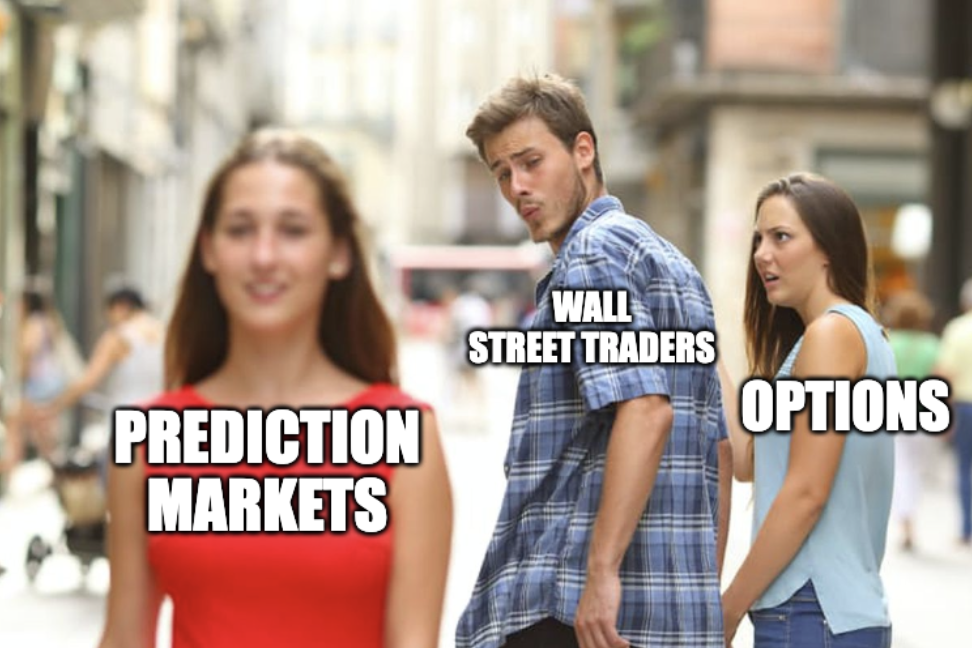
MEME OF THE DAY 😂

Want to get the most out of ChatGPT?
ChatGPT is a superpower if you know how to use it correctly.
Discover how HubSpot's guide to AI can elevate both your productivity and creativity to get more things done.
Learn to automate tasks, enhance decision-making, and foster innovation with the power of AI.