📊 Democrats declare war on death bets
Plus: A judge calls Kalshi's sports bets gambling, and the SEC and CFTC finally make up
GM. You’re reading PredictionDesk, the daily newsletter that helps you become a prediction markets expert in under 5 minutes.
Here’s what we got for you today:
⚖️ Democrats introduce dueling bills to restrict prediction markets before Republicans loosen the rules
📜 Judge calls it "absurd" that every sportsbook would need CFTC regulation
🤝 New cross-agency initiative launches six workstreams targeting prediction market and crypto rules
📈 Market Moves
📊 Odds & Ends

DEMOCRATS BET AGAINST PREDICTION MARKETS ⚖
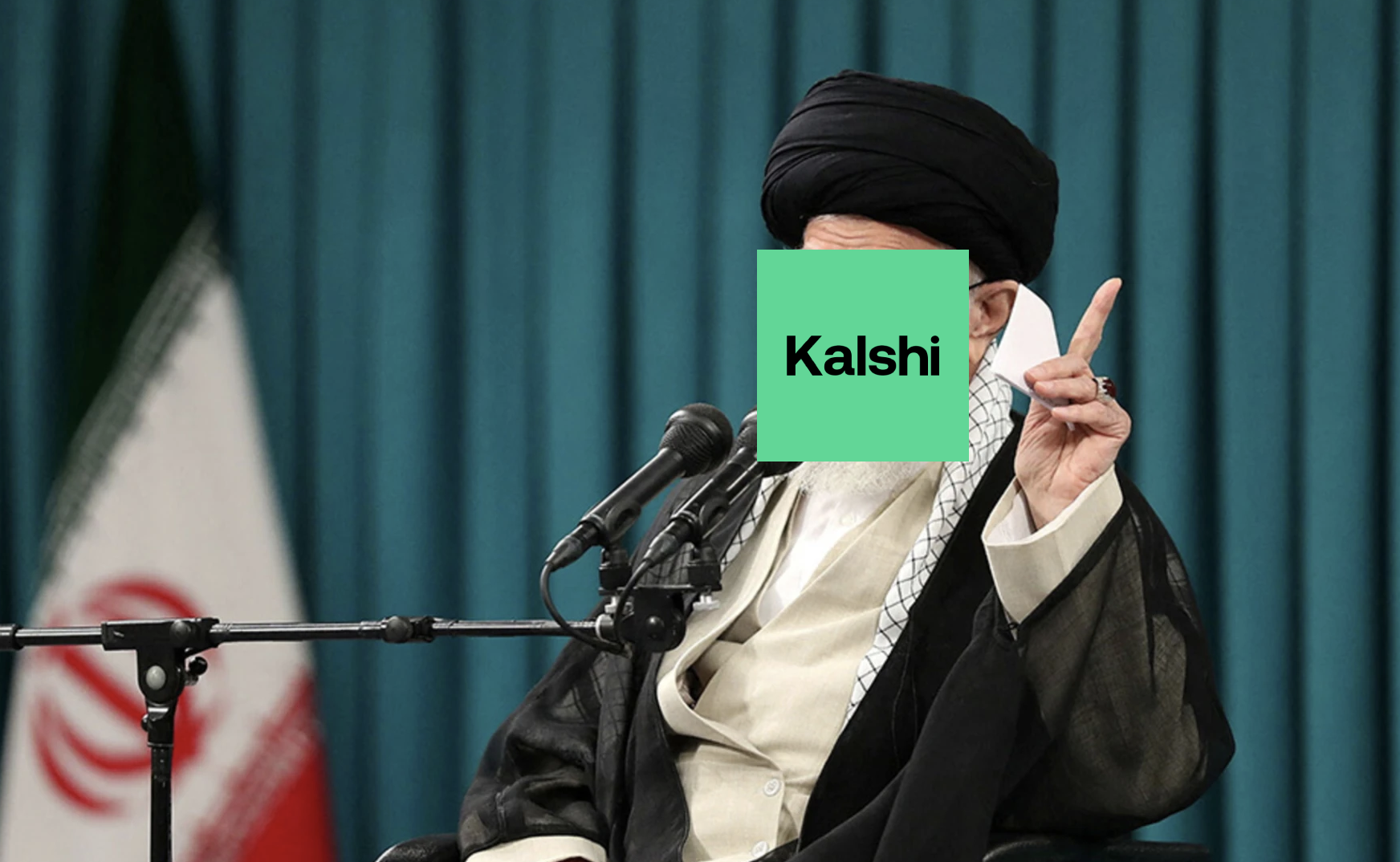
Sen. Adam Schiff and Rep. Mike Levin introduced the DEATH BETS Act on Monday, a bicameral bill that would explicitly ban CFTC-registered exchanges from listing contracts tied to terrorism, assassination, war, or an individual's death. The bill amends the Commodity Exchange Act to add language that, as the sponsors note, "is not currently referenced" in the statute. What prompted it isn't abstract: over half a billion dollars was wagered on the timing of U.S. military strikes on Iran, and a contract on whether Ali Khamenei would be "out as Supreme Leader" hit $54 million in volume on Kalshi before the exchange paused it.

The death clause doesn't just ban contracts that directly reference someone's death. It reaches anything that "could otherwise be construed as correlating closely" to it, a standard broad enough to catch contracts on, say, a head of state's tenure if the most likely resolution is assassination. The war and terrorism bucket includes "any similar activity, as determined by the Commission," giving the CFTC discretion to expand the categories without new legislation. For platforms designing contracts, the ambiguity cuts one way: when in doubt, don't list it.
On the same day, Sen. Richard Blumenthal and Rep. Andy Kim rolled out a separate bill with a wider scope. The Prediction Markets Security and Integrity Act would bar the use of material nonpublic information in prediction market trading, require 21+ age verification, and condition platform operation in any state on a state-approved wagering program. Its most aggressive provision would clarify that prediction markets aren't exempt from state oversight by excluding them from the Commodity Exchange Act entirely, a direct shot at the federal preemption argument Kalshi has used to fend off state regulators.
The CFTC formally withdrew its 2024 event contracts rulemaking in February and pulled a 2025 staff advisory on sports contracts, clearing the decks for what Chairman Selig says will be a new, more permissive framework. Democrats are watching the regulatory apparatus move in the opposite direction from where they want it, and they're trying to lock restrictions into statute before the window closes.
Whether any of this passes is another question. Republicans control both chambers, and the industry's lobbying arm is built for exactly this fight. But even if the DEATH BETS Act stalls, specific figures like "$500 million wagered on Iran strikes" are now in legislative text, giving state attorneys general and future regulators a ready-made case file. Schiff and Blumenthal may not get these bills through this Congress, but they're building the evidentiary record for the next one.

JUDGE TO KALSHI: THAT'S GAMBLING, NOT A SWAP 📜
An Ohio federal judge denied Kalshi's request for a preliminary injunction on Sunday, holding that the company's sports-event contracts aren't "swaps" under the Commodity Exchange Act and that Ohio's gambling laws aren't preempted by federal derivatives regulation. Chief Judge Sarah D. Morrison's opinion out of the Southern District of Ohio goes further than Massachusetts did: rather than blocking Kalshi on public health grounds, it holds that sports contracts fall outside the CEA's protective umbrella entirely.

Under the CEA, a "swap" must be tied to an event "associated with a potential financial, economic, or commercial consequence." "Currency exchange rates, the weather, and energy costs all do that," Morrison wrote. "The number of points scored in the Huskies-Bobcats game does not."
She pushed the logic further: if sports-event contracts are swaps, then all sports bets are swaps, and every sportsbook in the country would need to move onto CFTC-regulated exchanges or shut down. Morrison called that result "absurd" absent clear congressional intent, and cited a 2010 Senate colloquy in which Senators Feinstein and Lincoln described contracts built around the Super Bowl or the Kentucky Derby as serving "no real commercial purpose" and being "used solely for gambling."
Even if these contracts were swaps, the court said Kalshi still couldn't prove preemption. Gambling regulation is classic state police power, Morrison wrote, and the CEA's own text leaves room for state oversight alongside CFTC jurisdiction. She also flagged a consumer protection gap: Ohio's sports betting age is 21, but Kalshi allows 18-year-olds to trade.
Kalshi plans to appeal and is framing this as a split from a recent Tennessee federal ruling that went the other way on preemption. But Morrison's reasoning attacks the definitional foundation of Kalshi's legal strategy, not just the application. If sports-event contracts aren't swaps, there's no CFTC exclusive jurisdiction to invoke. The argument for offering sports contracts nationwide without state licensing falls apart.

SEC AND CFTC FINALLY AGREE TO AGREE 🤝
The SEC and CFTC announced a new Memorandum of Understanding today formalizing coordination on policymaking, examinations, enforcement, and data-sharing across their overlapping jurisdictions. The agencies simultaneously launched a Joint Harmonization Initiative with six workstreams, co-led by Robert Teply at the SEC and Meghan Tente at the CFTC. The workstreams read like a punch list of every gray area prediction market operators have been navigating for years: clarified product definitions via joint rulemakings, a "fit-for-purpose regulatory framework" for crypto and emerging tech, and streamlined compliance for dually registered intermediaries.

Buried in SEC Chair Atkins' remarks from Monday is the detail that matters most for this industry. He flagged a specific harmonization target: resolving whether certain event contracts qualify as security-based swaps or other types of securities. That classification question has loomed over the space since platforms started listing contracts that look and feel like options on real-world events. If the agencies settle it through joint rulemaking rather than competing enforcement actions, it would replace years of jurisdictional ambiguity with something platforms can actually build around.
The MOU's language on new products is unusually direct. It commits both agencies to remove obstacles to the lawful introduction of "novel derivative products" and "novel crypto asset products," and requires advance coordination when either receives a proposal to list or trade them. It explicitly names "onchain, automated systems" as a driver blurring jurisdictional lines. There's also a "super-app" provision: the agencies will seek alternative compliance paths and a route for regulated super-apps, framed as part of a "minimum effective dose" approach to regulation - a direct opening for brokerages distributing event contracts to deepen their integration without navigating two separate compliance regimes.
That deregulatory posture favors well-capitalized players who can afford dual registration and stand to benefit most from a unified compliance pathway. Crypto-native startups operating in jurisdictional gaps may find the clarity cuts both ways: clearer rules are easier to follow, but also easier to enforce.
Whether this produces actual rulemaking or just a shelf of memos remains the open question. MOUs between the SEC and CFTC aren't new - this one supersedes a 2018 agreement that didn't exactly resolve the turf wars. But the explicit mandate to define event contracts and build a joint crypto framework is new, and the dedicated cross-agency staffing structure gives it more teeth than the last attempt. For prediction markets, the best-case outcome is a regulatory regime where a CFTC-approved event contract isn't simultaneously an unregistered security. That alone would be worth the paperwork.

MARKET MOVES 📈
📈 Biggest swing: "West Bromwich Albion FC vs. Southampton FC: O/U 2.5" moved 49% -> 0% (Polymarket)
💰 Top earner: @HorizonSplendidView -- $1,958,709 24H Profit (Polymarket)
🤔 Weirdest market: "Will Trump say "Jesus" this week? (March 8)" at 100% odds (Polymarket)

ODDS & ENDS 📊
Underdog acquired Aristotle Exchange's CFTC-registered DCM and DCO, bringing sports event-contract listing and clearing in-house instead of relying on partner infrastructure.
Polymarket is deploying Palantir-powered screening to detect suspicious activity and banned participants as sports-linked event contracts face mounting integrity scrutiny.
Kalshi added a Threads sharing feature that lets users embed forecast charts directly into posts - a distribution play as prediction-market conversation spreads across social platforms.

RATE TODAY’S EDITION
Go from AI overwhelmed to AI savvy professional

AI will eliminate 300 million jobs in the next 5 years.
Yours doesn't have to be one of them.
Here's how to future-proof your career:
Join the Superhuman AI newsletter - read by 1M+ professionals
Learn AI skills in 3 mins a day
Become the AI expert on your team