📊 The billion-dollar prediction market hiding in plain sight
Plus: Goldman Sachs takes a stance on prediction markets, Kalshi and Polymarket battle it out for parlay dominance
GM. You’re reading PredictionDesk, the daily newsletter that helps you become a prediction markets expert in under 5 minutes.
New year, new logo. And if you're looking for your next role in prediction markets, we're connecting readers with opportunities, just reply to this email.
Here’s what we got for you today:
💰 The $1B prediction market you've never heard of
🏦 Goldman Sachs bets on prediction markets
🎰 Big players making bets on big parlays
📈 Market Moves
📊 Odds & Ends

INTERACTIVE BROKERS BUILT A $1B PREDICTION MARKET 💰
One prediction market has quietly racked up $1 billion in volume, $10M in fees, and $300M in peak open interest. During the 2024 election, it was a top-3 platform.
Most people have never heard of it.
It's ForecastEx, run by Interactive Brokers. While Polymarket and Kalshi dominate the conversation, ForecastEx has been operating quietly in the background and pushing a use case the others aren't talking about.
They offer contracts on economic, political, and climate events. But the interesting angle is using their prediction markets as an alternative to traditional insurance.

Zoom out: Traditional insurance is priced so you lose money on average. That's the point. Your premium covers the insurer's overhead, their reinsurance costs, and their profit margin. You're paying for the privilege of protection.
Prediction markets flip this. In a perfectly efficient market, hedging through forecast contracts would be free. No company taking a cut, just you finding someone willing to bet the other way.
For example, say a Miami hotel wants to protect against hurricane damage. On ForecastEx, they buy 10,000 YES contracts on "major hurricane hits Florida" at 10 cents each. Cost: $1,000. If a hurricane hits, each contract pays $1 and they collect $10,000. If it doesn't, they lose the $1,000 but their hotel is fine.
On the other hand, a typical insurance company charges $1,400 for the same $10,000 payout. Same protection, 40% more expensive with their added premium.
Prices will settle higher than pure probability but lower than what insurance companies charge. You're still saving money because there's no middleman.
There's also no guesswork. Insurance premiums are black boxes. Good luck figuring out if you're getting a fair deal. But if a hurricane contract trades at 10 cents, the market is telling you there's a 10% chance. You can agree or disagree, but at least you know what you're buying.
You can also leverage ForecastEx for speed. Say a utility company sees a weather model predicting hurricane formation in the Caribbean. With insurance, they're stuck waiting for their next renewal. With prediction markets, they buy contracts that afternoon and adjust as the forecast evolves.
The main limitation to this model, however, is liquidity. You can't get $10 million in coverage yet as there aren't enough counterparties. But ForecastEx is CFTC-registered, and Interactive Brokers has a built-in client base to bootstrap participation. Their incentive coupon, which pays interest on the market value of your position, encourages holding longer-dated contracts, exactly what climate hedging requires.
This isn't meant to replace insurance. It's a faster, more transparent complement. As liquidity builds, the hedging applications unlock.

GOLDMAN SACHS WANTS IN 🏦
Goldman Sachs is actively exploring prediction markets. On Thursday’s earnings call, CEO David Solomon confirmed the bank has a team studying the space and that he personally met with leaders of the "two big prediction companies" in the last two weeks.
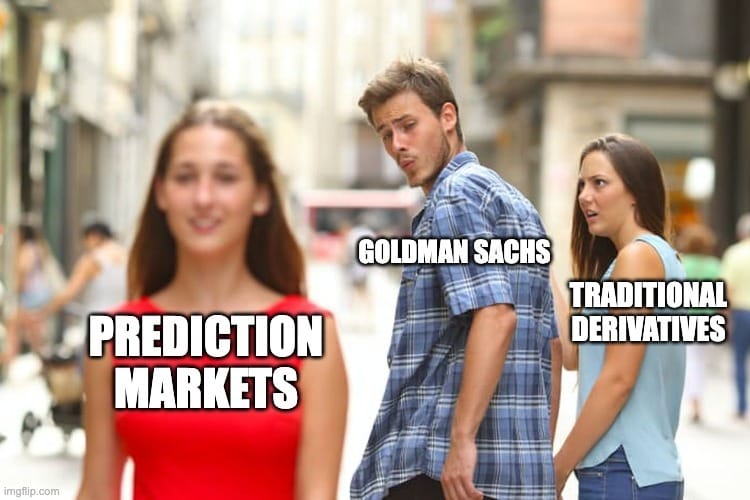
Solomon described the sector as "super interesting" after spending hours with each firm. While he didn't name names, his emphasis on "CFTC-regulated" platforms points squarely at Kalshi. The other meeting was almost certainly with Polymarket, the volume leader, despite its complex regulatory history in the U.S.
He tempered expectations on timing. "The pace of change might not be as quick and as immediate as some of the pundits are talking about," Solomon said. But he added that Goldman is "spending a lot of time" on it.
The entrance of a major Wall Street bank could bring real liquidity and distribution to the space. Whether that means market-making, client access, or something else, Solomon didn't say. But for an industry fighting for legitimacy, having the CEO of Goldman Sachs validate the asset class, and commit internal resources to it, is a massive credibility shift.

POLYMARKET & KALSHI ADD PARLAYS 🎰
Prediction markets are looking to take over the most lucrative part of sports betting in the United States.
If you’ve been following, you might remember how Polymarket and Kalshi exploded into the mainstream after staking huge valuations and attracting Wall Street attention. Now they’re trying to crack parlays, the multi-leg bets that drive most sportsbook profits in states like New Jersey, where they account for the lion’s share of online betting revenue.

Kalshi has rolled out a feature called “combos,” which managed more than $100 million in weekly volume by letting users stitch together outcome bets across games. Polymarket hasn’t matched that yet, instead offering preset bundles and dangling bonuses to traders who help build liquidity. Both firms are racing to draw the capital and users needed to make these complex bets tradable on their platforms.
There’s a legal and trust dimension to all of this. Kalshi’s practice of self-trading through an internal unit has sparked a class-action complaint alleging conflicts of interest. Traditional sportsbooks like DraftKings and FanDuel remain skeptical that prediction markets can ever match the breadth of bets they offer.
Whether or not Kalshi or Polymarket can actually become the future of sports wagering, this moment marks a real inflection point. For now, they’re scaring big sportsbooks, eating profits as they go.

MARKET MOVES 📈
📈 Biggest swing: “Will Trump and Machado not shake hands when they meet?” moved 8% → 90% (Polymarket)
💰 Top earner: @simonbanza - $277,502 24H Profit (Polymarket)
🤔 Weirdest market: “Will Epstein Data Set 9 be released before March?” (Polymarket)

ODDS & ENDS 📊
Space partners with Kamino to offer yield on every prediction market position.
The NCAA is trying to exercise more control over prediction markets on college sports. Classic case of if you can’t beat them, then join them.
Draftkings makes potential turnaround from prior prediction markets failure

RATE TODAY’S EDITION